Shanghai Court Blames Parents for Toddler’s Death in Seat‑Adjustment Tragedy, Igniting Child‑Safety Debate.
In late spring of 2023 a heartbreaking tragedy unfolded on a bustling Shanghai street, one that would later dominate Chinese social media and courtrooms alike. At around 10:30 a.m. on 1 May, Zong Mou was driving a commercial van with his wife and two young children aboard. The family was stopped at a traffic light when Wu Mou, the mother, noticed their five‑year‑old daughter fiddling with the rear‑row seat. In the seconds that followed the seat reclined, thrusting the child’s head against the back of the third‑row seat where their two‑year‑and‑seven‑month‑old son lay. Emergency responders later determined the boy had died from hypoxic‑ischemic encephalopathy – essentially suffocation caused by a lack of oxygen – a result of the crushing pressure applied by the seat.
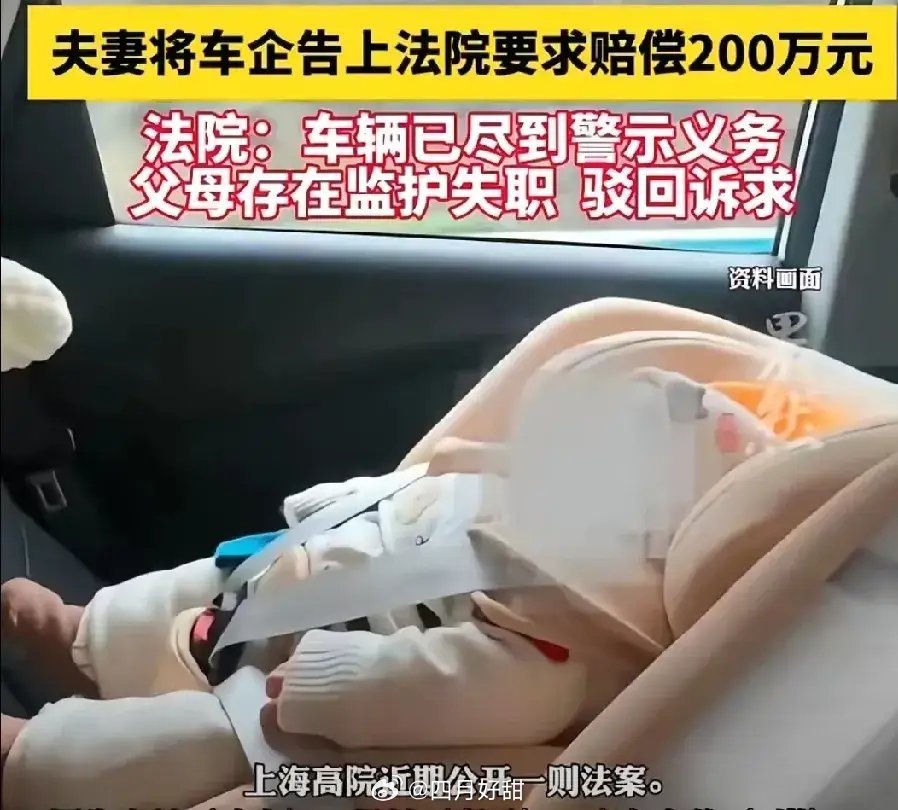
The loss of the toddler set the grieving parents on a legal quest that would bring them before the Shanghai High People’s Court. In the months after the accident the couple filed a civil suit against the vehicle’s manufacturer, seeking 2 million yuan in compensation on the grounds of product liability. Their claim hinged on the argument that the car’s design and user instructions had failed to adequately warn parents about the dangers of children operating seat adjustments while the vehicle was in motion.
On 14 August 2025 the case reached a decisive moment. The Shanghai High Court, after a public hearing that attracted extensive media coverage, dismissed the parents’ claim and unequivocally placed primary responsibility on them. In its ruling the court cited a series of “guardian negligence” violations: the failure to install a legally required child safety seat for the younger boy; the decision to leave both children unattended in a moving vehicle; permitting the five‑year‑old to manipulate the seat without supervision; and an overall lack of vigilant monitoring throughout the journey. The judgment also noted that the vehicle’s manual explicitly cautioned against allowing children to adjust seats while the car was traveling, undermining the parents’ argument that the manufacturer bore any blame.
The court’s decision reverberated across Weibo, where the hashtag “女儿压死儿子事件第一责任在父母” (Daughter crushes son to death: primary responsibility lies with parents) quickly trended. Users from the Guangzhou Daily to independent commentaries such as “难舍深蓝” weighed in, echoing the court’s view that the tragedy was a direct product of parental oversight. Common threads in the online discourse included sharp criticism of the parents for “甩锅” – shifting the blame onto the manufacturer – and a broader admonition that child safety seats are a non‑negotiable safeguard rather than an inconvenience. Many netizens expressed that while they felt sympathy for the family’s loss, any attempt to evade accountability was “荒谬至极” (absurd) and “让人不齿” (unpalatable).
The case has also revived conversation about China’s child‑safety regulations. In Shanghai, as in many major cities, children under four are required by law to be secured in an approved child restraint system. Enforcement, however, remains uneven, and the incident underscores the gap between legal mandates and everyday practice. Child‑safety advocates see the ruling as a potent reminder that parental vigilance, not merely the presence of a seatbelt, is essential to protecting children in vehicles.
Beyond the courtroom, the tragedy has sparked a broader societal reckoning. Legal scholars point out that while product liability can play a role in accidents involving faulty equipment, courts are increasingly unwilling to absolve parents of their fundamental duty of care when negligence is evident. The Shanghai High Court’s judgment aligns with a growing body of Chinese jurisprudence emphasizing that guardians are “the first line of defense” for minors, and that any claim to the contrary invites public censure.
In the wake of the ruling, Zong and Wu Mou have not publicly responded, and the vehicle manufacturer has declined comment beyond reiterating that its products meet all safety standards and that user manuals contain clear warnings. For the Chinese public, however, the episode has already cemented a clear message: when a child’s life is lost due to preventable oversight, the blame rests squarely on those charged with their protection.
The sorrowful episode of a five‑year‑old unintentionally causing her two‑year‑old brother’s death is a stark illustration of how a momentary lapse in supervision can have irreversible consequences. It serves as a sobering reminder that, regardless of technological safeguards, the primary guardians of children’s safety remain the parents and caregivers themselves.