Unitree Falls to No. 2 Among Humanoid-Robot Stocks as China's Robot Rally Sputters
Four trading days after its explosive debut, Unitree — China's 'humanoid robot first stock' — has slipped below American challenger Figure AI in market value, as investors begin to ask whether a robot maker without much factory revenue can justify a multi-billion-dollar valuation.
Unitree Robotics spent months building a reputation as the purest way to bet on China's humanoid-robot future. It took the stock four days to hand the crown back.
The Hangzhou-based robot maker listed on August 19 at a moment of maximum investor excitement. Set at 150.80 yuan a share, the stock opened at 1,100 yuan, more than six times its issue price, and at its peak the company was worth about 444.9 billion yuan. It was, briefly, one of the most richly priced robot companies on earth. Then the market lost its nerve.
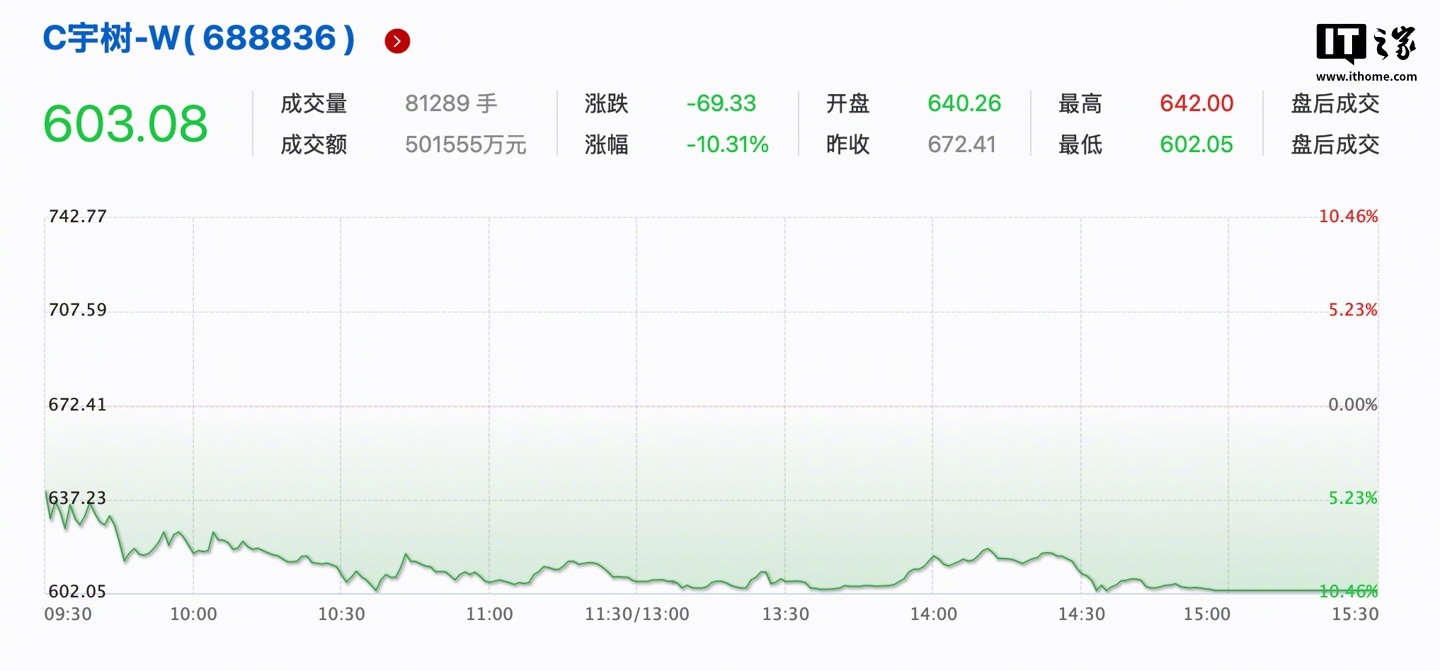
By the close on August 24, Unitree's share price had fallen to 603.08 yuan, a one-day drop of more than 10 percent, leaving the company valued at around 243.9 billion yuan. More than 200 billion yuan of notional value — roughly 28 billion dollars — evaporated in four sessions. At that level, Unitree slipped below Figure AI, the American humanoid start-up, in terms of market capitalisation, a shift that netizens on Zhihu and Baidu treated as a minor inflection point for the whole industry. Unitree's shares were still far above their issue price, but the "humanoid robot first stock" title had been downgraded to second place.
Part of the story is simply the arithmetic of a hot IPO. Unitree's debut was extreme: shares began trading up sixfold, then swung through one of the heaviest first-day turnovers on record, as early holders rushed to sell into the frenzy. A correction was almost guaranteed. But the online reaction pointed to a second, more substantive factor.
"The valuation logic is changing," one widely shared Weibo post argued. Investors, the account said, no longer reward a robot company merely for promising humanoid hardware. They want to see what the industry calls "具身智能" — embodied intelligence — actually working in a factory, a warehouse, a use case that produces revenue. For a company whose robots have mostly appeared in demonstrations, research videos and, memorably, this summer's humanoid Olympics, that bar is now higher. A market cap in the hundreds of billions of yuan, the logic went, cannot rest on a video of a robot flipping or running a race; it has to be earned by robots doing jobs.
The episode is a useful reminder of how fast China's AI and robotics mania has moved from delight to discipline. Unitree is still a pioneer in a sector the state has identified as strategic, and its robots remain among the most advanced small humanoids in the world. But investors are no longer grading it on enthusiasm. They are grading it like any other company — on whether the machines can do the work, and get paid for it.