What Long-Term Joblessness Takes From You: China Counts the Losses
A Weibo question about what long-term joblessness takes from a person drew more than 40,000 engagements over a working Sunday — the price of a holiday-swap weekend. The answers split into two ledgers of loss, revealing how little household slack sits behind China's work debates.

"What does long-term joblessness take from a person?" The question, posted on Weibo over a text-card image with a crying emoji, has sat high on the trending list for two days and drawn more than 40,000 engagements — not because it is novel, but because it was asked on the worst possible Sunday.
That Sunday was a working one. Under China's holiday-swap system, a weekend is dismantled and reassembled into a longer National Day break later, so millions spent the day at desks to buy time off they will not see for weeks. Into that mood, Wang Teng — a startup founder whose company is named, fittingly, Today Is Fit for Rest (今日宜休) — posted that short stitched-together breaks are "really not worth forcing" — they disrupt work and life rhythms and are too short to travel on. White Deer Video put his complaint on the record; another commenter did the holiday math: assembled breaks exist to get people traveling and spending, and flights, hotels and tickets rise to meet them.
The answers to the question split into two ledgers. The first counts losses: a résumé gap that widens monthly, skills that stale, a social world that shrinks to the family group chat. The second counts recoveries — and it supplied the thread's most-liked reply, from a woman who had quit a high-pressure job with no plan. What she lost, she wrote, was the breast lump, the depression, the constant anger; "everything leaves me in a mild 'whatever, forget it' state. Truly, it's the happy who step back" — the reply's phrasing playing on the catchphrase "幸福者退让" (the happy yield first), the season's shorthand for defusing conflict by letting go.
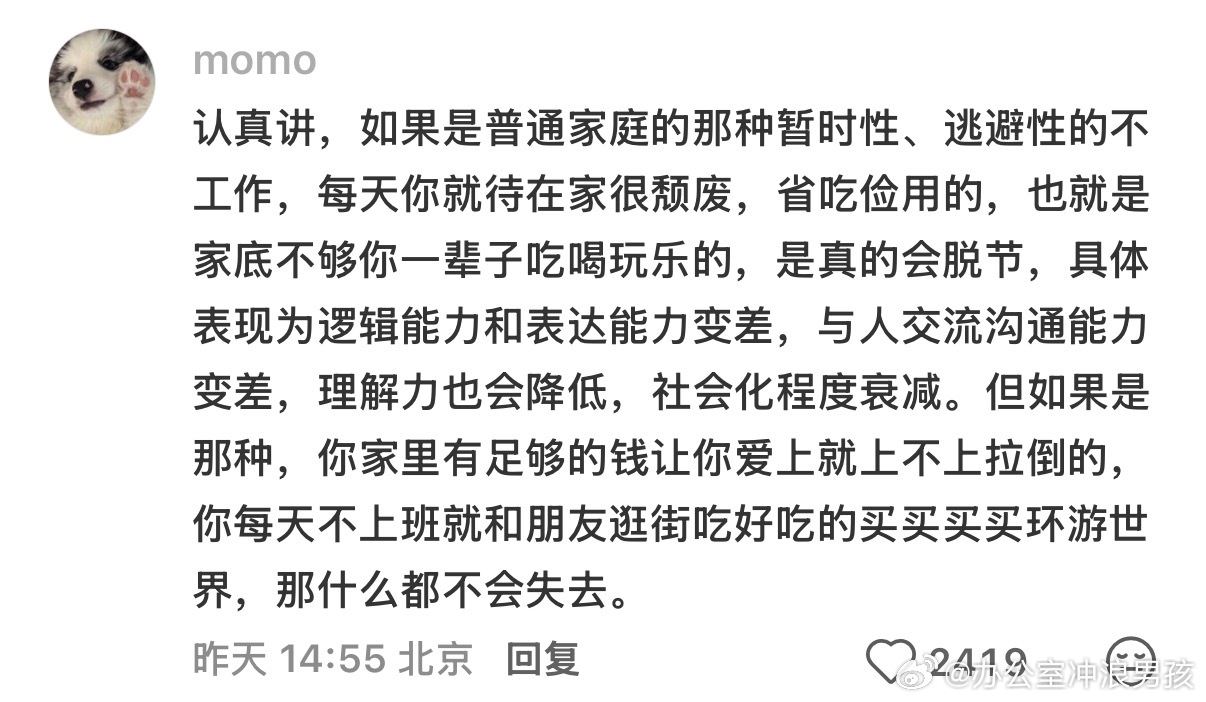
Beneath both camps sits the dividing line another commenter drew, liked more than 2,400 times: for an ordinary family, long joblessness "really does disconnect you — your socializing declines"; but "if the family has enough money, you won't lose anything." Which is to say the question is really about household slack, and China's households have been running thin of it.
There is also a sharper version of the Sunday-off story that the thread surfaced, and it belongs to people who never had a weekend to swap. As one widely shared post worked it out: those with a two-day weekend merely work Saturday and rest Sunday; the frightening case is the worker on a single rest day, for whom Saturday was already a workday and the swap now claims Sunday too — ten-odd days on the job without a break, "more than a beast of burden could stand" (就算是牲口也扛不住). The country's holiday calendar, in other words, is distributed as unevenly as its work is, and the labor law itself does not actually mandate a two-day weekend.
Neither answer to the viral question wins, because both are true on different ledgers: with savings, the cost of not working is social; without them, it is immediate and material. The replies have kept arriving all through the working weekend, and the tally that matters next is not likes at all — it is the consumption figures from the National Day break that the swapped Sundays were meant to produce.