A Death in a CAR-T Trial Puts China's Booming Cancer-Drug Industry Under Scrutiny
A 49-year-old gastric-cancer patient died of brain hemorrhage weeks after joining a CAR-T trial at a top Shanghai hospital. Yimufeng Biotech, IPO-bound, denies the drug was to blame; his widow is pursuing a judicial appraisal over the monitoring she says failed him.
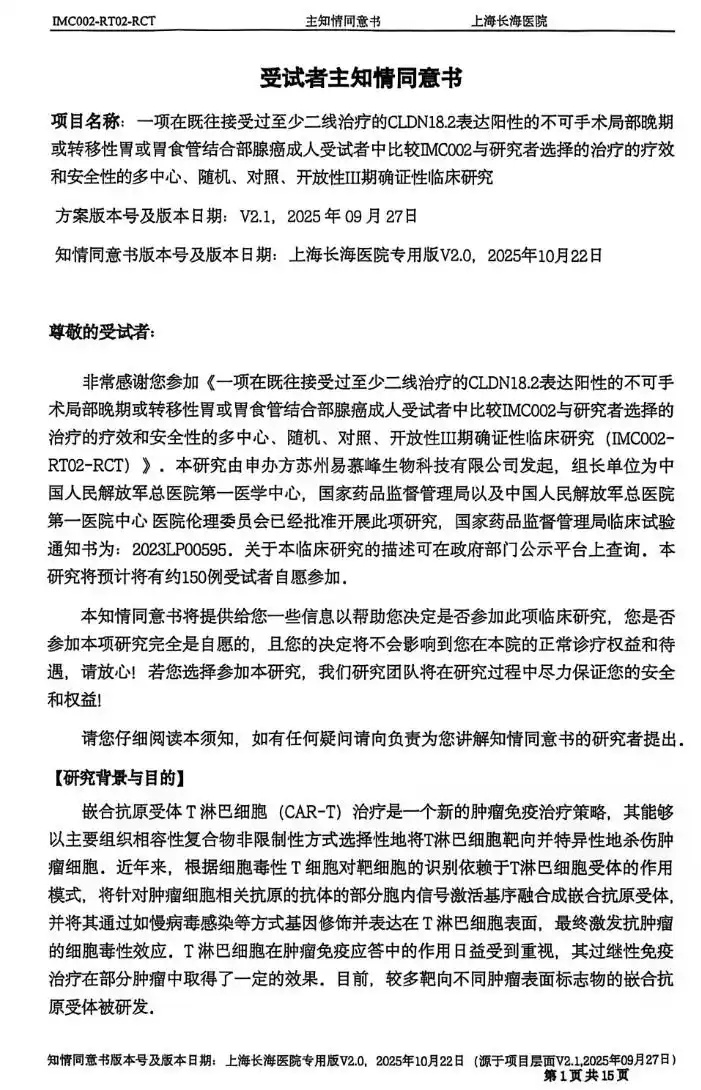
A 49-year-old Shanghai executive with stomach cancer seemed, by his family's account, to be doing fine: chemotherapy had his disease under control when his doctor suggested something newer — a place in a clinical trial for a CAR-T cell therapy code-named IMC002, run by a Suzhou biotech called Yimufeng. Weeks later he was dead of a brain hemorrhage, and on September 4 the story of his final days sat at the top of Baidu's trending board, his widow speaking to reporters about what she calls gaps in his post-treatment monitoring.
CAR-T therapy — reprogramming a patient's own immune cells to attack tumours — is one of the most promising and most hazardous frontiers of cancer medicine, and China has built one of the world's busiest pipelines of trials. IMC002 targets CLDN18.2, a molecular marker common in gastric cancer, a disease China diagnoses in roughly half a million people a year. For Yimufeng, the trial is the company's lead asset as it prepares for a stock-market listing — which is why the death, first reported by the financial outlet Lanjing News, landed at a sensitive moment. The company has said it is cooperating with the investigation and does not believe the hemorrhage was caused by the drug.
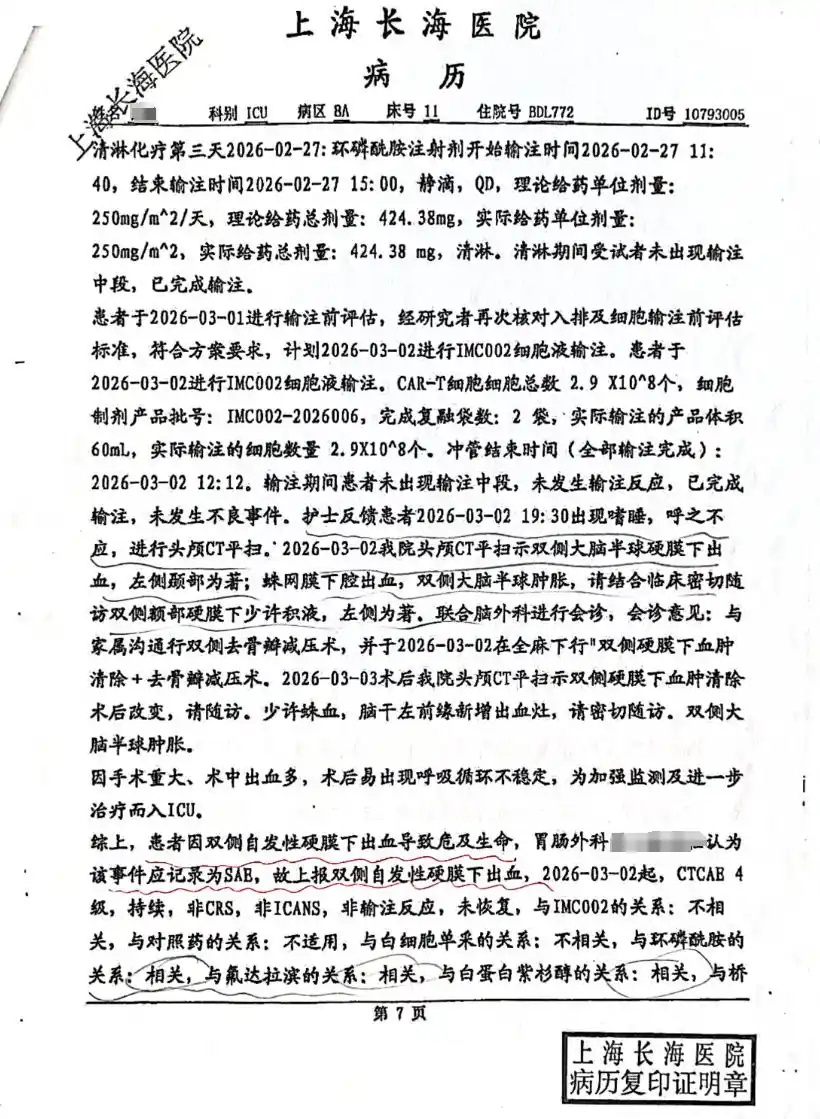
The family's account, laid out in interviews and in pages of his hospital file that circulated on Weibo, turns on the hours after the infusion. His wife, Cheng, says he showed abnormal signs the same afternoon, but staff assumed he had fallen asleep; by seven in the evening he could not be woken. A page of the record from Shanghai's Changhai Hospital documents what followed — bleeding on both sides of the brain, and emergency surgery to relieve the pressure. She is now pursuing a formal judicial appraisal to establish causation, the standard path Chinese families take when they want an authoritative answer about a death in care.
Neurotoxicity is a known risk of CAR-T treatment, and Chinese medical associations publish monitoring protocols meant to catch it early; the question Cheng's account raises is whether those protocols were followed while there was still time to act. The signed consent form in the file, with its dense enumeration of possible harms, is its own kind of document: a patient told, in principle, exactly what he was risking.
How the appraisal settles the causal question will matter well beyond one family. China's experimental-oncology boom depends on patients — often out of options, often paying — volunteering for trials at hundreds of hospitals, and on the trust that the system watches them closely enough. It is a mechanism this site examined last month, when three successive forensic reviews produced three different verdicts in a maternal death case. A verdict that finds the drug blameless but the monitoring negligent would still be a finding someone must answer for.