China Recalls 4.3 Million Cars Over Door Handles That Can Trap Passengers in a Crash
Nine carmakers led by Tesla and Xiaomi are recalling 4.2751 million new-energy vehicles — the largest single-defect recall in Chinese history — because the mechanical emergency releases tucked inside their flush electronic door handles are too hard for passengers or rescuers to find when a crash cuts the power.
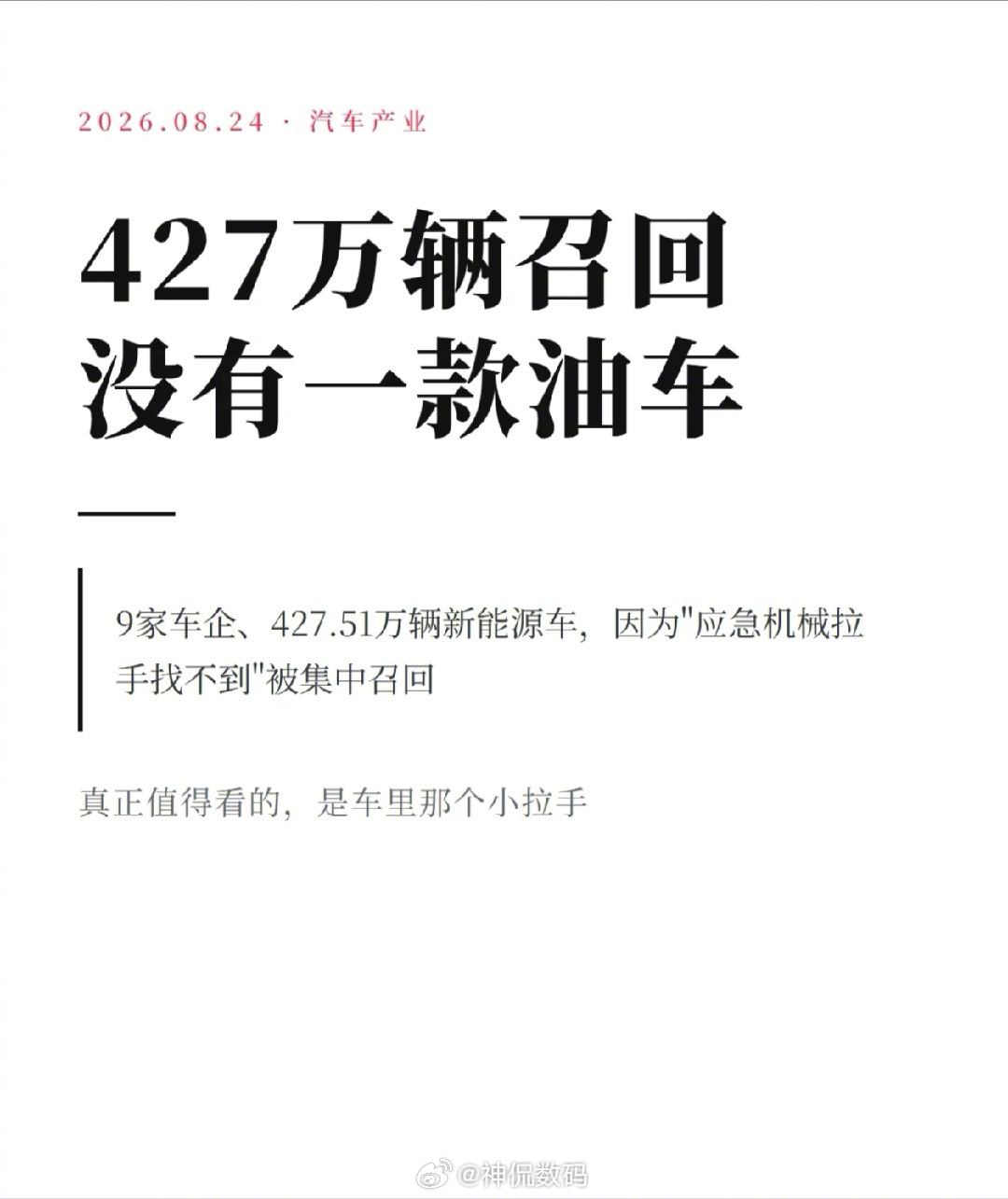
China's market regulator has ordered one of the largest single-defect recalls in the country's automotive history — and every car in it is electric. The State Administration for Market Regulation announced that nine carmakers, among them Tesla and Xiaomi, are recalling a combined 4.2751 million new-energy vehicles because the emergency mechanical release handles inside their doors are difficult to identify, a defect that could block occupants from escaping after a collision severs the car's electrical power.
The flaw is a byproduct of one of the defining design gestures of China's EV boom: the flush, hidden door handle that sits flat in the bodywork and presents a seamless surface. In everyday use the electronic latches work perfectly. The problem is what happens in the worst moment of a car's life — a violent impact that cuts power can leave the doors locked, and the mechanical backup pull, recessed in a door pocket or finished in the same color as the panel, can be nearly impossible to locate in the dark or in smoke, by a disoriented passenger, a child, or a rescuer trying to get in.
The arithmetic of the announcement is stark. Tesla alone accounts for roughly 2.98 million of the recalled vehicles, with Xiaomi and seven other domestic manufacturers supplying the rest. The recall — the largest ever triggered by a single defect in China, by one count — landed as the top item on Baidu's search board, where the story was framed as 4.27 million cars caught in an "escape dilemma."
On Weibo, one observation drew particular attention: not a single combustion-engine car is in the recall. "427万辆召回 里面没有一款油车?" asked the digital commentator behind a widely shared text card — no gasoline car even made it to the table — because the defect stems from the hidden electronic handles that only new-energy models standardized. Another tech post traced the root cause the same way: hidden electronic door handles carry no safety redundancy, flawless in daily use yet a liability once an extreme collision cuts the current, and the mechanical pull passengers were never taught to look for becomes the only way out.
The recall is a measure of how thoroughly one design fashion has spread through the world's largest market for electric cars. Flush handles slim a car's silhouette and shave a sliver of drag, so they became standard from budget crossovers to flagship sedans — and the safety question migrated with them. A generation of Chinese drivers learned to unlock a car by touching a button that wasn't visibly there. Now the state has effectively told the industry, at a scale of more than four million vehicles, that a door must still open the old-fashioned way when everything else goes dark.