China Makes Self-Driving Safety a Legal Floor: Mandatory National Standards for L2 to L4
Two mandatory national standards published by the industry ministry set a legal safety floor for driver-assist and autonomous systems, requiring them to match a 'qualified and attentive human driver' and barring the marketing hype that has blurred what cars can actually do. They take effect in 2027.
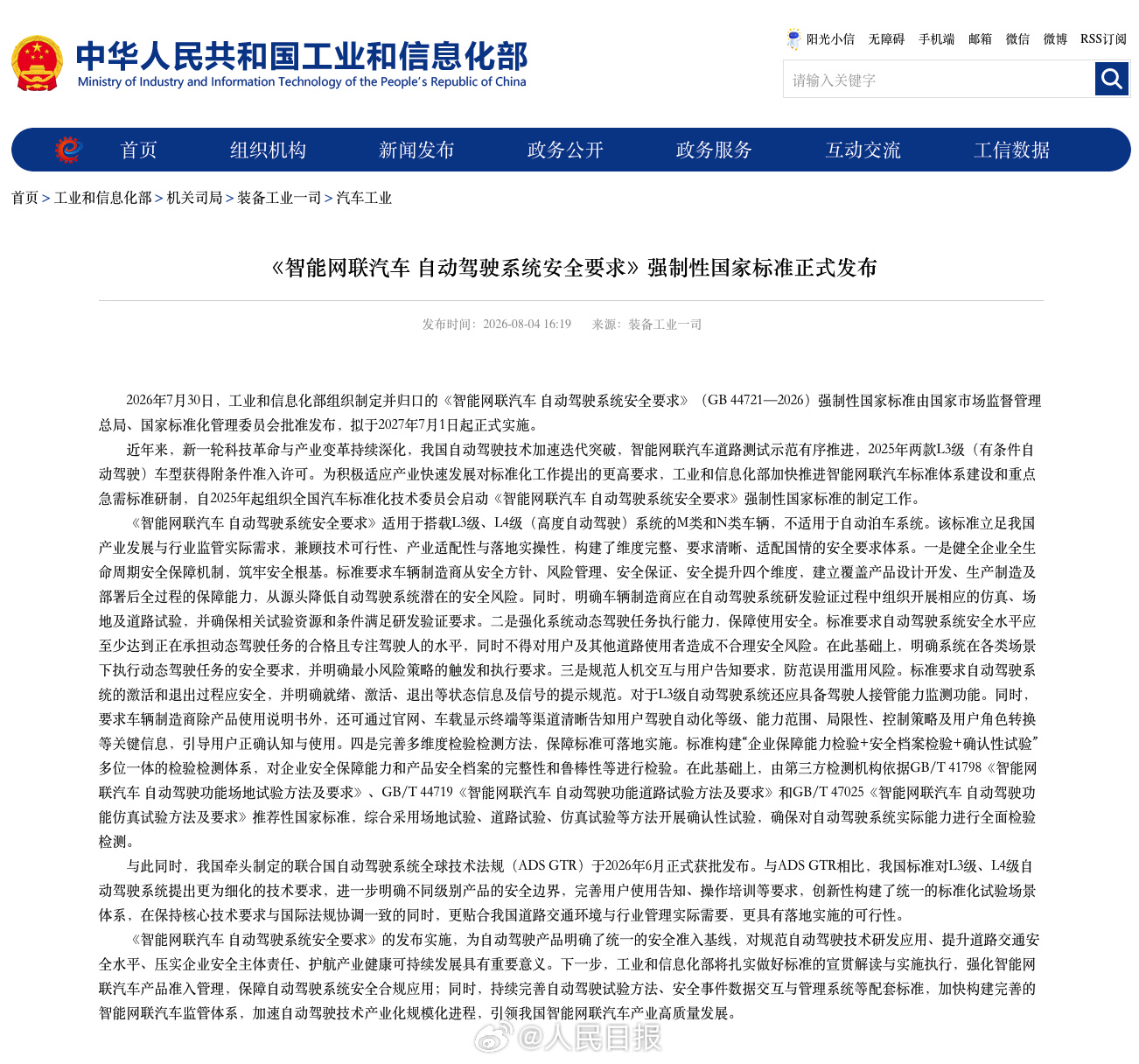
China has published its first mandatory national standards for intelligent driving, converting what automakers could treat as aspirations into legal requirements. Two documents approved on July 30 — GB 47955—2026 for Level 2 combined driving assistance and GB 44721—2026 for Level 3 and Level 4 automated driving — take effect on January 1 and July 1, 2027 respectively, giving the industry a one-year countdown. People's Daily carried the full text of the announcement.
The L3/L4 standard is the more consequential. It applies to passenger and goods vehicles equipped with high-automation systems (though not self-parking), and requires manufacturers to build safety management covering design, production, and post-deployment operation — risk management, safety assurance, verification by simulation, track and road testing. The benchmark is written directly into the text: an autonomous system must be at least as safe as "a qualified and attentive driver performing the dynamic driving task," and must not impose unreasonable risk on other road users. Level 3 systems, where a human must be ready to take over, are required to monitor whether the driver is actually capable of taking over. Manufacturers must tell owners — via manuals, websites, or the dashboard — exactly what the system can do, what it cannot, and who is responsible at any given moment.
The timing matters. In 2025, China granted conditional approval to its first two L3 models, and driver-assist features have become the fiercest battleground of the domestic car market, with "smart driving" appended to sales pitches for cars in every price bracket. Regulators have already moved against the gap between marketing and capability — as we covered when Beijing flagged BYD's fuel-consumption claims — and the new standard extends that discipline from the showroom to the code. The rules also arrive as the law races to catch up on liability: Chinese legal scholars have proposed tiered responsibility for "human-machine co-driving" crashes, noting that traditional traffic law assumes a human is always in charge.
Commenters on the announcement read it as a wading-rope for the industry. "From a recommended standard to a mandatory one; capability has to match a qualified and attentive driver; no more wild claims — capabilities and limits must be stated plainly," as one auto-industry blogger summarised the changes. Another put the stakes more bluntly: with the bar written down, next year will show "who is genuinely good, and who was bluffing."
The standards form one piece of a broader regulatory sweep across China's electric-vehicle industry, from battery safety to a recall of 4.3 million cars over door handles that can trap passengers in a crash. For exporters, the significance is bigger than domestic road safety: China is writing the rulebook for a technology the rest of the world is still litigating, and it is doing so with the world's largest fleet of connected cars to test it against.